China Best Fabric Shower Curtain Manufacturers
China Best Fabric Shower Curtain Manufacturers are worth comparing carefully, because a polished catalog does not reveal how a product performs after repeated use. A Fabric Shower Curtain may look simple, yet fabric weight, weave, stitching, water resistance, and colorfastness all shape its quality. Details matter. For buyers, the useful questions are practical: Can the supplier provide clear material specifications? Are sample colors and finished dimensions consistent? How are seams, hems, and hanging holes checked before shipment?
China’s manufacturing market includes suppliers with different product ranges, production capabilities, and levels of customization. A reliable comparison should consider documented quality procedures, communication, lead times, sample approval, and the ability to explain production limits. Ask for proof. Request product samples and written specifications, then inspect the fabric by hand and review stitching, odor, drape, and finish. If testing claims are important, ask which test methods and reports support them, and confirm that the documents apply to the exact product being quoted.
Price alone can be misleading. A lower quotation may reflect a different fabric construction, packaging choice, or inspection scope. Even a good sample can hide inconsistencies across a large order; that is not always easy to judge from a catalog. Thoughtful sourcing means checking details, asking direct questions, and keeping approved specifications in writing. The strongest manufacturer relationship is not just about a curtain that looks right on screen, but one that matches the agreed requirements when it arrives.
Fabric Shower Curtains in China: Materials and the 72 × 72 in Standard Size
China Best Fabric Shower Curtain Manufacturers
Fabric shower curtains made in China are commonly offered in polyester, cotton, and blended fabrics. Polyester is lightweight and dries relatively quickly, making it a practical choice for bathrooms with limited ventilation. Cotton feels softer and hangs with more weight, but it may need a washable liner and careful drying. Blends can balance texture and easy care, though performance depends on fabric construction and finishing. Ask suppliers for fabric weight, care instructions, and details about water-repellent treatment. These details matter more than a product photo.
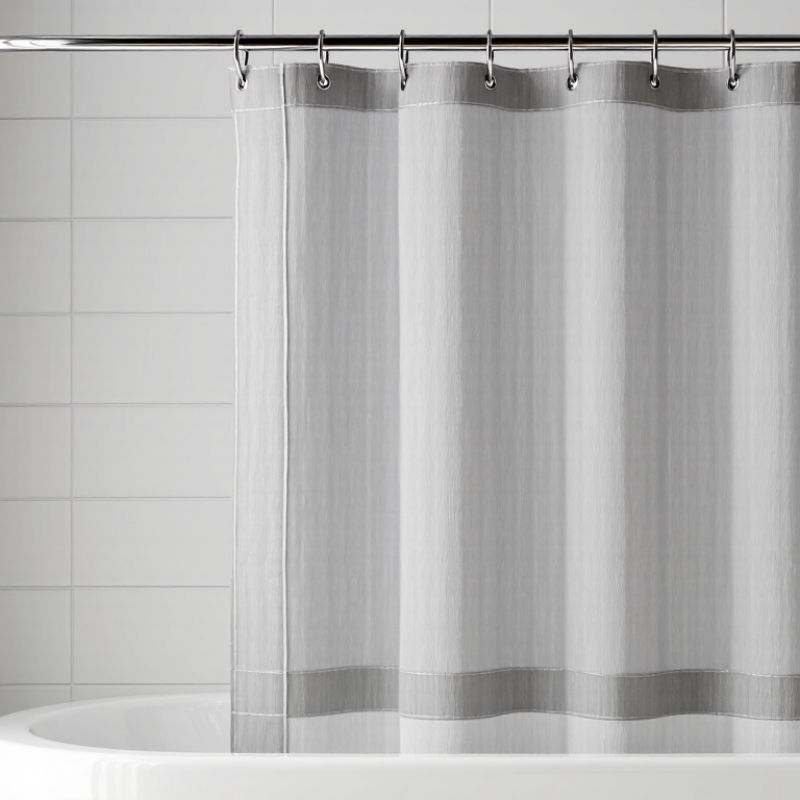
The 72 × 72 inch size is a familiar standard for many bathtub-and-shower setups. It measures about 183 × 183 centimeters. Still, “standard” does not mean universal. Measure the curtain rod height and the distance from the rod to the tub rim before confirming an order. Measure before ordering. A curtain that is too short may let water escape; one that is too long can bunch near the tub. That sounds simple, but room layouts vary.
For production inquiries, specify finished dimensions, top-header style, buttonhole spacing, hem width, and packing method. Request a sample to check drape, stitching, and color under bathroom lighting. Minor shade changes can happen between fabric batches, so confirm acceptable tolerances in writing. I would not rely on size labels alone; a clear measurement sheet prevents avoidable surprises.
Polyester, Cotton, and Blends: Comparing Fiber Content and Fabric Weight (GSM)
Polyester, Cotton, and Blends: Comparing Fiber Content and Fabric Weight (GSM)
Fiber choice changes how a shower curtain feels and dries. Textile Exchange’s Materials Market Report 2024 estimates polyester made up about 57% of global fiber production in 2023, reflecting its broad use and availability. Polyester curtains generally dry quickly and hold their shape, while cotton offers a softer, more absorbent feel. A polyester-cotton blend can balance those qualities, though its performance depends on the blend ratio and construction. There is no perfect fiber for every bathroom.
Fabric weight, measured in grams per square metre (GSM), helps compare similar fabrics. ASTM International’s D3776/D3776M method provides a standard way to measure fabric mass per unit area. A lighter curtain may hang easily and dry faster; a heavier one can feel more substantial and drape closer to the tub. But GSM alone does not prove durability or water resistance. A dense fabric can still dry slowly, and a higher number is not automatically better. That detail is easy to overlook.
Tips: Check the fiber blend and GSM together. For cotton, consider ventilation and drying time. Ask suppliers for test results, and compare samples in the same lighting. A small sample may not show the curtain’s full drape.
Water Repellency Tests: AATCC TM22 Spray Ratings and ISO 811 Pressure
For China Best Fabric Shower Curtain Manufacturers, water repellency should be checked with two tests, not one. AATCC TM22 uses a controlled spray and rates visible wetting on a 0–100 scale. A rating of 100 indicates no sticking or wetting; lower scores show increasing surface wetting. This gives buyers a quick comparison of how the curtain face handles splashes. Still, it is a visual test, not a measure of waterproof pressure. (AATCC TM22)
ISO 811:2018 measures resistance to water penetration under rising hydrostatic pressure. The result is reported as pressure, often in kilopascals or centimetres of water. That matters when a curtain has a dense coating or laminated backing: droplets may bead on the face while pressure testing reveals weak spots. Ask suppliers to identify the tested side, conditioning, and sample construction. Seams and hanging holes may need separate checks. Small details matter. A strong laboratory result can also overstate everyday performance if the sample is new and unwashed. Request results after laundering when durability is important, and compare like-for-like test conditions. (ISO 811:2018)
China Best Fabric Shower Curtain Manufacturers – Water Repellency Tests: AATCC TM22 Spray Ratings and ISO 811 Pressure
| Test dimension |
AATCC TM22 |
ISO 811 |
How to report or interpret the result |
| Primary property assessed |
Resistance of a fabric surface to wetting by water spray |
Resistance of a fabric to water penetration under hydrostatic pressure |
These methods assess different properties; their results are not interchangeable. |
| Test approach |
Water is sprayed onto a specimen mounted at an angle; the specimen is visually assessed for surface wetting. |
Water pressure is applied to one side of the specimen, and penetration is observed as pressure increases. |
Use the current standard edition and the laboratory’s documented test procedure. |
| Result format |
Visual spray rating on a 0–100 scale |
Hydrostatic pressure at the specified endpoint, reported in the units used by the laboratory, such as kPa or cm H₂O |
Record the measured result, test direction, specimen details, and number of replicates. |
| What a higher result indicates |
Less visible surface wetting during the spray assessment |
Greater resistance to water penetration under the test conditions |
A higher result does not, by itself, establish suitability for every shower-curtain application. |
| What the test does not establish |
It does not directly measure hydrostatic resistance or prove that a fabric is fully waterproof. |
It does not directly measure spray repellency or assess seam and finished-product leakage. |
Consider construction, coating, seams, care, and finished-product testing as relevant. |
| Recommended report fields |
Specimen identification; face tested; individual and average ratings; conditioning and test date |
Specimen identification; test direction; pressure endpoint; individual and average results; conditioning and test date |
Include the standard designation and edition, laboratory, and any deviations from the method. |
| Results in this table |
No specimen result provided |
No specimen result provided |
Actual ratings and pressure values require testing of the specific fabric by a competent laboratory. |
Note: This is a test-method comparison, not a product test report or certification.
Factory Quality Control: Colorfastness, Seam Strength, and AQL Sampling
Fabric shower curtains need to keep their color and shape through repeated washing and daily contact with water. At the factory, colorfastness checks can include washing, damp rubbing, and dry rubbing. A white test cloth makes dye transfer easy to spot. Inspectors should also compare the tested fabric with an approved color sample under consistent lighting. Small details matter. A shade can look correct in a dim inspection area and noticeably different near a bright bathroom window.
Seam strength deserves a practical check. Pulling stitched panels by hand can reveal loose threads, but it does not replace a measured load test. A useful inspection records the force applied and checks whether stitches break, skip, or distort the fabric. AQL sampling helps teams inspect a defined sample from each production lot rather than relying on a few convenient pieces. The sampling plan and defect categories should be agreed before production; otherwise, “acceptable” can mean different things to different people. Inspect seams, grommets, hems, and visible stains, and record each finding. Factory tests cannot perfectly reproduce every home wash. That limitation is worth stating, not hiding.
Choosing Chinese Manufacturers: Certifications, Minimum Orders, and Lead Times
A fabric shower curtain supplier should provide current certificates and explain exactly which products they cover. Ask for the issuing body, validity dates, and test scope, rather than accepting a logo on a brochure. Paper is not proof. For polyester or blended fabric, request recent test reports for colorfastness, shrinkage, and water repellency. Confirm that the tested material matches your sample; small changes in coating or dye can affect performance.
Minimum order quantities often depend on fabric availability, printing, and custom dimensions. A stock fabric may allow a smaller trial order, while custom colors can require more meters than expected. Request separate quotes for samples, pilot runs, and repeat orders. Check whether packaging, rings, and labels count toward the minimum. Low minimums sound attractive, but unit costs may rise. I would compare the full landed cost, not just the curtain price.
Lead times should be broken into sample approval, material sourcing, production, inspection, and shipping. Ask for a calendar estimate with milestones, and clarify when the clock starts. A supplier might quote production time but exclude fabric sourcing. That detail is easy to miss. Build in extra time for color approval and corrections, especially before a seasonal launch. Written updates help, though schedules can still slip when materials arrive late.
China Fabric Shower Curtain Sourcing: Typical Lead-Time Ranges
Indicative calendar-day planning ranges for common order stages. Actual timing depends on fabric availability, customization, order quantity, and factory capacity.
Sample development and approval commonly take about 7–15 days. Standard bulk production may take 25–45 days, while custom-printed orders may take 35–55 days. These are planning estimates, not guaranteed delivery times. Confirm the supplier’s current certifications and their scope, minimum order quantity, and production schedule in writing before placing an order.