Leave Your Message
A Stall Shower Curtain can look like a small bathroom detail. Yet, for global buyers, it affects privacy, maintenance, packaging, and customer satisfaction. Its narrower format suits compact bathrooms, guest rooms, dormitories, and rental properties. A practical choice. Sourcing teams must examine more than color and price. They should review fabric weight, water resistance, stitching, grommet strength, and odor after unpacking. These details reveal whether a product can survive repeated use across different markets. Good sourcing begins with evidence.
Experienced buyers often request samples before approving bulk production. They hang the curtain on a standard stall rod and check its drop, drape, and hem alignment. Water beads should form consistently, not disappear into uneven fabric. The curtain should also dry reasonably quickly in a humid room. Suppliers need clear specifications, inspection records, and stable communication. Certifications and labeling requirements may differ by destination, so local compliance checks remain essential. A factory photograph is not enough. It never is. Comparing samples from several suppliers can expose differences in coating, colorfastness, and finishing quality.
Global sourcing also involves carton size, folded creases, lead time, and replacement planning. A lightweight Stall Shower Curtain may reduce freight volume, but thinner material can tear near the rings. That trade-off deserves honest testing. Buyers should consider recycled fibers, packaging reduction, and safe production practices without making unsupported environmental claims. Trust grows when suppliers disclose limitations as clearly as strengths. No Stall Shower Curtain fits every bathroom or market. That is the part some catalogs avoid saying. A disciplined sourcing process turns a simple item into a dependable, market-ready product.
What Is a Stall Shower Curtain?
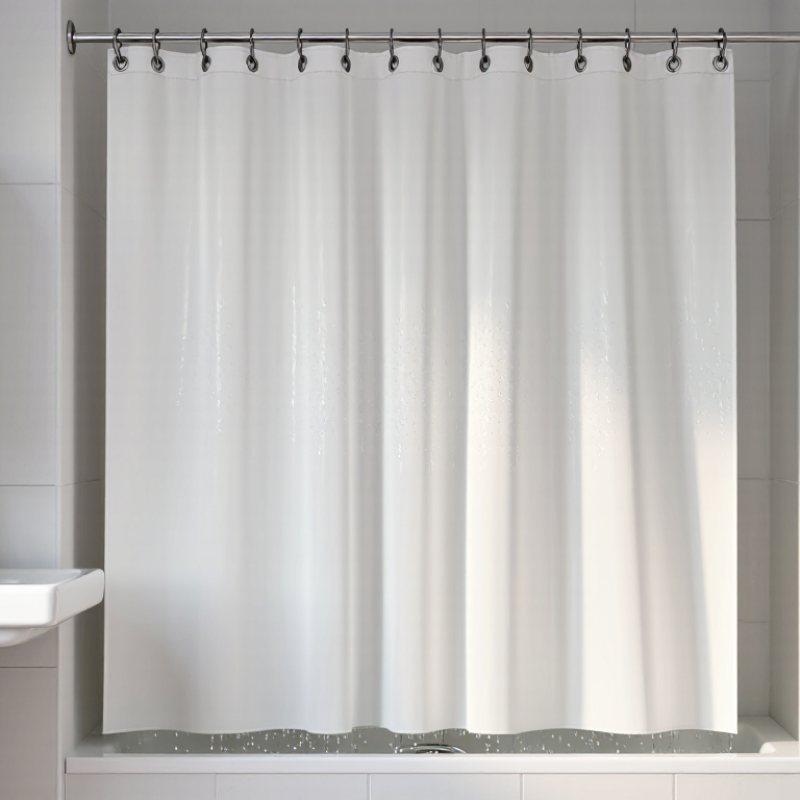
A stall shower curtain is a narrow curtain designed for compact shower enclosures. It hangs from a straight rod and controls water near the entry. Common dimensions include 36 by 72 inches or 48 by 72 inches. Exact sizing varies by region and bathroom design. Unlike a full tub curtain, it usually needs less fabric and fewer hooks. Still, a curtain is not a waterproof wall.
In supplier evaluations, a common mistake is checking appearance before measuring the enclosure. ASTM F2270 addresses shower curtain construction, performance, and care. Its guidance supports closer checks on seams, hems, fasteners, and fabric stability. The U.S. EPA WaterSense specification limits labeled showerheads to 2.0 gallons per minute. Lower water flow can reduce splash, but it cannot correct poor curtain placement. Global sourcing teams should review shrinkage, odor, grommet strength, and packaging space.
Tips: Request a physical sample before approving bulk production. Measure width, drop, and hook spacing separately. Test the curtain after repeated washing. A waterproof coating may feel effective at first, then weaken. That detail is easy to miss. Ask suppliers for material composition and care instructions. Also check whether the packed product remains crease-resistant after long storage. Small stalls expose design flaws quickly.
| Data Dimension | Typical Specification or Fact | Global Sourcing Relevance |
|---|---|---|
| Product Definition | A stall shower curtain is a narrower curtain designed for a shower stall rather than a full bathtub enclosure. | Its compact format is suitable for bathrooms with limited floor space, including apartments, hotels, dormitories, and compact residential projects. |
| Common Widths | Approximately 36, 42, or 48 inches wide, equivalent to about 91, 107, or 122 centimeters. | Offering several widths helps buyers match different stall openings and regional bathroom layouts. |
| Common Heights | Approximately 72, 78, or 84 inches high, equivalent to about 183, 198, or 213 centimeters. | Height selection should consider the shower rod position, ceiling height, ventilation, and the required amount of floor clearance. |
| Recommended Finished Width | The curtain is commonly made wider than the opening so it can create folds and provide better visual coverage. | Buyers should specify both the actual opening width and the finished curtain width to reduce fitting problems. |
| Polyester Fabric | A widely used textile option that is lightweight, flexible, printable, and generally washable when care instructions permit. | It supports broad design customization and is often practical for private-label and hospitality programs. |
| PEVA or EVA | Flexible plastic materials commonly used for water-resistant shower liners and curtains; PEVA is a chlorine-free alternative to PVC. | They are suitable when easy cleaning, water resistance, and lower textile complexity are priorities. |
| PVC | A plastic material historically used for shower curtains and liners, offering water resistance and low cost. | Importers should review destination-market chemical requirements because regulations and retailer policies may restrict certain substances or PVC applications. |
| Header Hole Spacing | Many shower curtains use approximately 6-inch spacing between header holes, although the exact layout varies by product. | The spacing should be confirmed against the intended hooks, rings, or roller system before production. |
| Header Construction | Common constructions include reinforced top hems, sewn-in header tape, metal or plastic eyelets, and rust-resistant grommets. | A reinforced header improves load distribution and helps reduce tearing during repeated opening and closing. |
| Bottom Hem | A weighted or reinforced bottom hem can help the curtain hang more evenly and reduce movement caused by airflow. | Specify the hem type, weight method, and material because these details affect drape, safety, and shipping weight. |
| Water Resistance | Most shower curtains are water-resistant rather than completely waterproof; performance depends on material, coating, seams, and construction. | Samples should be checked for water repellency, leakage through seams, drying behavior, and resistance to mildew-related odor. |
| Care Requirements | Textile curtains may be machine washable depending on construction; plastic curtains are commonly wiped clean with mild soap and water. | Clear care labels help reduce returns and support compliance with retail and consumer-information requirements. |
| Design Customization | Available options can include solid colors, printed patterns, translucent panels, textured surfaces, decorative hems, and multiple header styles. | A simple rectangular structure makes the product relatively easy to customize for different market preferences. |
| Packaging Efficiency | The product can be folded or rolled into a compact retail package, especially when made from lightweight fabric or flexible plastic. | Compact packaging can improve container utilization and reduce storage requirements compared with rigid bathroom products. |
| Quality-Control Points | Check dimensions, color consistency, print alignment, seam strength, header-hole position, grommet attachment, odor, stains, and surface defects. | A written inspection checklist helps maintain consistent quality across production batches and international shipments. |
| Key Buyer Specification | The purchase specification should state finished dimensions, tolerance, material, fabric weight or thickness, color standard, header design, hem style, packaging, and labeling. | Detailed specifications make quotations easier to compare and reduce ambiguity between buyers and suppliers. |
| Why Choose for Global Sourcing? | Stall shower curtains are lightweight, space-efficient, customizable, and available in widely understood rectangular dimensions. | These characteristics can simplify product development, packaging, shipping, assortment planning, and adaptation to different bathroom markets. |