How to Buy Lace Tablecloths Wholesale in 2026?
Buying Lace Tablecloths wholesale in 2026 can help retailers, event planners, and hospitality businesses manage costs while keeping tables looking polished. But a low price alone does not make a good purchase. Fabric quality, lace pattern, sizing, and supplier communication all affect how a tablecloth looks and performs. A delicate floral design may suit a wedding venue, while a simpler border can work better for restaurants that wash linens often. Small details matter.
This guide explains how to compare wholesale suppliers, assess samples, and plan quantities with fewer surprises. Check measurements against your actual tables, including the drop you want on each side. Ask about fabric composition, color consistency, care instructions, packaging, minimum order quantities, and lead times. If possible, inspect a sample under the lighting where the cloth will be used; bright showroom photos can hide differences in texture or shade. It happens.
Reliable sourcing also takes clear records. Keep written details of product specifications, quoted prices, delivery estimates, and any agreed quality checks. Review return terms before placing a large order, and leave room in your schedule for delays or sample revisions. No checklist can remove every risk, and supplier claims deserve verification. With practical checks and realistic expectations, you can choose Lace Tablecloths that fit your budget, intended use, and customers’ preferences.
Define Lace Tablecloth Specifications Using Fiber Content, Construction, Size, and Finish
How to Buy Lace Tablecloths Wholesale in 2026?
Define each lace tablecloth specification before requesting wholesale prices. Start with fiber content. Textile Exchange’s Materials Market Report 2024 states that polyester represented about 57% of global fiber production in 2023. Cotton accounted for roughly 19%. This matters for cost, drape, drying speed, and recycling claims. Request fiber percentages, not vague terms such as “cotton feel.” Verify uncertain claims through laboratory testing or supplier certificates.
Construction changes appearance and durability. Ask whether the lace is knitted, woven, embroidered, or chemically finished. Record mesh density, pattern repeat, edge structure, and fabric weight in grams per square meter. A dense floral pattern may look luxurious but can snag during folding. I once approved a beautiful sample with a weak scalloped edge. It failed after repeated banquet setup. That mistake was avoidable.
Measure finished dimensions after laundering. Specify table length, width, drop length, tolerance, and shrinkage allowance. A 30-centimeter drop can become uneven after washing. AATCC TM135 is commonly used to assess dimensional change during home laundering. Ask for test results, wash temperature, drying method, and colorfastness data. Finish details also need precision. Define prewashing, mercerization, softening, stain resistance, and flame performance separately. “Easy care” is not a measurable specification. For 2026 purchasing, include inspection samples, packaging conditions, and a written acceptance standard. Small omissions become expensive.
How to Buy Lace Tablecloths Wholesale in 2026?
Define Lace Tablecloth Specifications Using Fiber Content, Construction, Size, and Finish
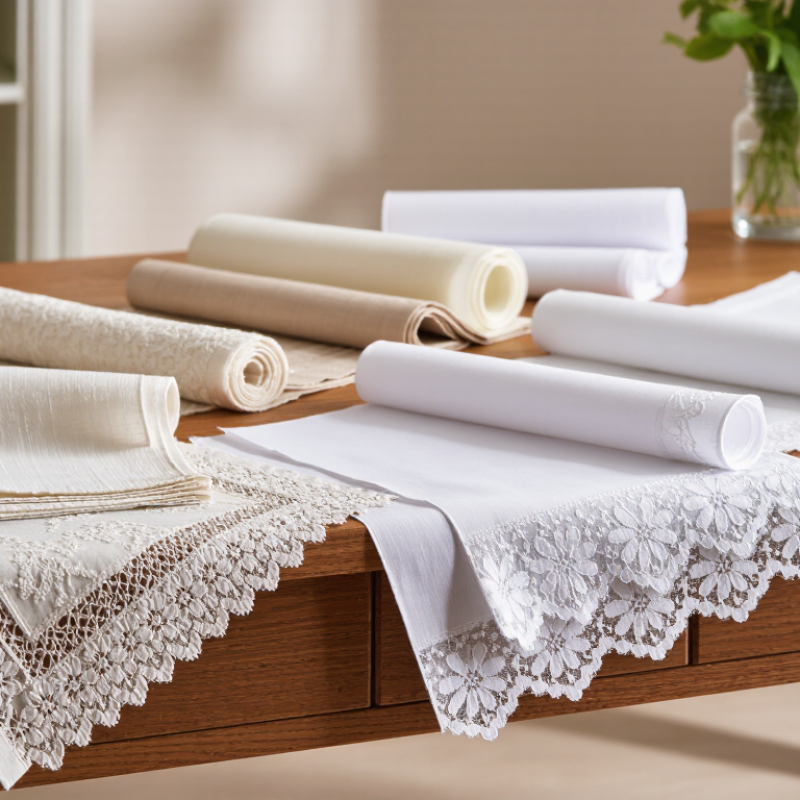
Use the chart to compare common wholesale tablecloth dimensions before requesting quotations. Confirm whether measurements refer to the finished cloth or the usable lace panel, then calculate the required drop for the table height. For fiber content, specify 100% polyester for easy-care use, 100% cotton for a natural hand feel, or a defined polyester-cotton blend. Also record the construction, such as all-over lace, lace overlay, or lace border, together with the finish, including hemmed edges, scalloped edges, dyed color, or wrinkle-resistant treatment.
Verify Supplier Quality with ASTM D5430’s 4-Point Fabric Inspection System
How to Buy Lace Tablecloths Wholesale in 2026?
Lace tablecloths can look perfect under showroom lighting. Defects often appear after unpacking. During wholesale sourcing, request an ASTM D5430 four-point inspection before shipment. This system assigns penalty points according to defect severity and length. Inspectors review the full fabric surface, not only selected samples. That difference matters.
For lace, check broken motifs, uneven scallops, holes, stains, skipped threads, and loose edges. Mark each defect by roll number and position. A practical inspection should also measure width at several points. Keep the inspection light consistent. Textile Exchange’s Materials Market Report 2024 reported global fiber production at about 124 million metric tonnes in 2023. Such volume increases the need for documented quality control. Cheap production does not guarantee stable lace construction.
Ask suppliers for inspection records, defect photos, fabric composition, and packed-roll measurements. Compare the report with your purchase specification. ASTM D5430 helps create a common language, but it cannot replace experienced judgment. It may miss subtle shade variation or poor drape. I have seen fabric pass a visual check yet disappoint after washing. That is an uncomfortable lesson. Request a small pre-production sample, then test laundering, shrinkage, and edge recovery. Allow realistic tolerance limits in your contract. Rejecting every tiny irregularity may waste usable material. Accepting too many defects can damage customer trust.
Compare Wholesale Quotes by MOQ, Unit Cost, Lead Time, and Shipping Terms
How to Buy Lace Tablecloths Wholesale in 2026?
Wholesale lace tablecloth quotes should be compared line by line, not by unit price alone. Start with the minimum order quantity, or MOQ. A supplier offering 500 pieces may quote $3.20 each, while another requires 2,000 pieces at $2.70. The lower price may leave cash tied up in slow-moving inventory. Ask whether mixed sizes, colors, or patterns count toward the MOQ.
Check the unit cost against material weight, edging quality, stitching, and packaging. Request a physical sample before approving bulk production. Measure its finished size after washing. Small shrinkage can affect banquet layouts. Samples matter. A beautiful photograph proves very little. Quote validity also deserves attention, especially when fabric and freight costs change during 2026.
Lead time should include sampling, production, inspection, and dispatch. For example, “25 days” may exclude sample approval and public holidays. Request a dated production schedule. Then examine shipping terms carefully. Compare EXW, FOB, and delivered pricing, including inland transport, insurance, customs handling, and destination fees. A $2.70 tablecloth can become more expensive than a $3.10 option after freight. I have seen purchasing plans fail because these charges were treated as minor details. That judgment was too optimistic. Leave room for delays, rework, and imperfect forecasts.
Check Care Labels Against ISO 3758:2023 Before Approving Samples
How to Buy Lace Tablecloths Wholesale in 2026?
Before approving wholesale samples, inspect every care label against ISO 3758:2023. This standard provides a symbol-based system for communicating textile care instructions. Check washing, bleaching, drying, ironing, and professional textile care symbols carefully. Lace tablecloths often combine cotton, polyester, embroidery, coatings, and decorative edges. These materials may require different handling. A label that says “machine washable” may still hide risks, such as shrinkage, distortion, or color transfer.
Request a complete sample with its final label attached. Do not approve a loose label alone. Compare the stated fiber content with supplier test records and your own wash trial. Measure the tablecloth before and after washing. Photograph the lace pattern, corners, and hem. I have seen attractive samples lose their shape after one warm cycle. That small test can prevent a large purchasing mistake. Also confirm that symbol use matches the current ISO edition and any applicable market requirements.
Tips:
Wash one sample normally and another under harsher conditions. Record temperature, detergent, drying method, and measurements. Inspect the lace when damp and dry. Ask the supplier to explain every symbol in plain English. If the label feels unclear, pause approval. A cheaper order is not a better order when customers cannot care for it safely. Some suppliers may provide incomplete records. Treat that as a warning, not a minor delay.
Confirm HS Classification, Import Duties, and Order Documents Before Payment
Before paying for wholesale lace tablecloths in 2026, confirm the correct HS classification with a licensed customs broker. Classification may depend on fiber content, fabric construction, finishing, and intended use. Cotton lace and synthetic lace may enter under different tariff lines. Do not rely only on a supplier’s code. Customs authorities can reclassify goods after arrival, creating unexpected duty, tax, or storage costs. Request a written classification opinion when the product design is unusual.
Ask for a complete landed-cost estimate before approving the order. Import duties can vary by destination, country of origin, trade measures, and current tariff schedules. VAT, customs processing fees, and port charges may also apply. Check whether the quoted price uses FOB, CIF, or another Incoterm. The difference matters. A low unit price can hide expensive delivery obligations.
Prepare the order file carefully. It should include a purchase order, pro forma invoice, commercial invoice, packing list, sales contract, and shipping instructions. The invoice should state quantity, unit price, currency, material composition, net weight, gross weight, and origin. Confirm textile labeling or testing requirements before production. Verify bank details through an independent channel. I have seen buyers approve invoices too quickly, then discover mismatched weights or vague product descriptions. That mistake is avoidable, but not always cheap. Keep every revision, email, and approved sample with the payment record.