Choosing a PVC shower curtain for an international market involves more than comparing colors and prices. Buyers also need to consider dimensions, material thickness, reinforced holes, hem quality, and how easily the curtain can be cleaned. A product that looks sturdy in a listing may feel thin or stiff when handled. Small details matter.
This guide introduces seven options for global buyers and explains the practical differences worth checking before purchase. A Shower Curtain Pvc may suit buyers seeking a water-resistant, easy-care option, but quality can vary between suppliers. Some curtains may have a noticeable odor when new, while others may feel heavier or less flexible than expected. No curtain is perfect. These trade-offs deserve attention, especially when purchasing in volume.
We look at construction, usability, available sizes, and supplier information rather than relying on appearance alone. Buyers should request clear product specifications, inspect samples where possible, and confirm that listed measurements match their intended market. Packaging and communication matter, too. They affect storage, shipping, and the buying experience. Requirements for materials and product information can differ by destination, so verify the relevant standards before placing an order. This overview is a starting point, not a substitute for checking each product carefully.
PVC resin contains chlorine as part of its basic chemical structure. ECVM reports that chlorine makes up about 57% of PVC resin by weight. This figure describes the resin, not every finished shower curtain. Not the same thing.
Manufacturers may blend PVC with plasticizers, pigments, stabilizers, or other ingredients. Their amounts vary, so a curtain’s final composition and feel cannot be inferred from the resin figure alone. A product label or supplier specification offers more useful detail. Even then, descriptions can be incomplete.
For global buyers comparing shower curtains, PVC content is only one consideration. A transparent panel may feel light and flexible, while a thicker one can hang with less movement. But thickness alone does not prove better quality. Check the dimensions, seams, eyelets, and care instructions, and ask how the material handles repeated moisture and cleaning. Small details matter.
The chlorine percentage explains PVC’s chemistry; it does not, by itself, establish a product’s safety or performance. Keep those claims separate. Routine care also matters: ventilate the bathroom, rinse off residue, and follow the maker’s cleaning guidance. One limitation remains: without reliable product-specific information, buyers cannot tell exactly what additives were used.

PVC resin is approximately 57% chlorine by weight. The chart shows the approximate elemental composition of PVC, based on its repeating chemical unit (C₂H₃Cl).
Values are approximate and rounded. The chlorine figure is consistent with ECVM’s description of chlorine accounting for about 57% of PVC resin by weight.
PVC shower curtains can look alike online, but small specification differences affect fit and daily use. Compare thickness in mil or millimeters, and check how the seller defines that measurement. A thicker panel may feel sturdier, yet it can hang stiffly or take longer to dry. Thin descriptions like “heavy duty” are not enough. Ask for a stated thickness.
Measure from the shower rod to the tub or floor, then compare both curtain width and length with the product dimensions. Check whether measurements use inches or centimeters; a small conversion error can leave a gap or drag the hem. Hem weights help the curtain stay near the tub during airflow, but a weighted hem is not a substitute for correct sizing.
Inspect grommet spacing and material, too. Evenly spaced, reinforced openings are less likely to tear with regular pulling.
Small detail, big difference.
If specifications are missing, request a clear measurement chart before ordering. I would not assume a higher price means better construction; stitching and finishing can vary.
Read care instructions and confirm the return process in case the curtain arrives with uneven hems or poorly finished holes.
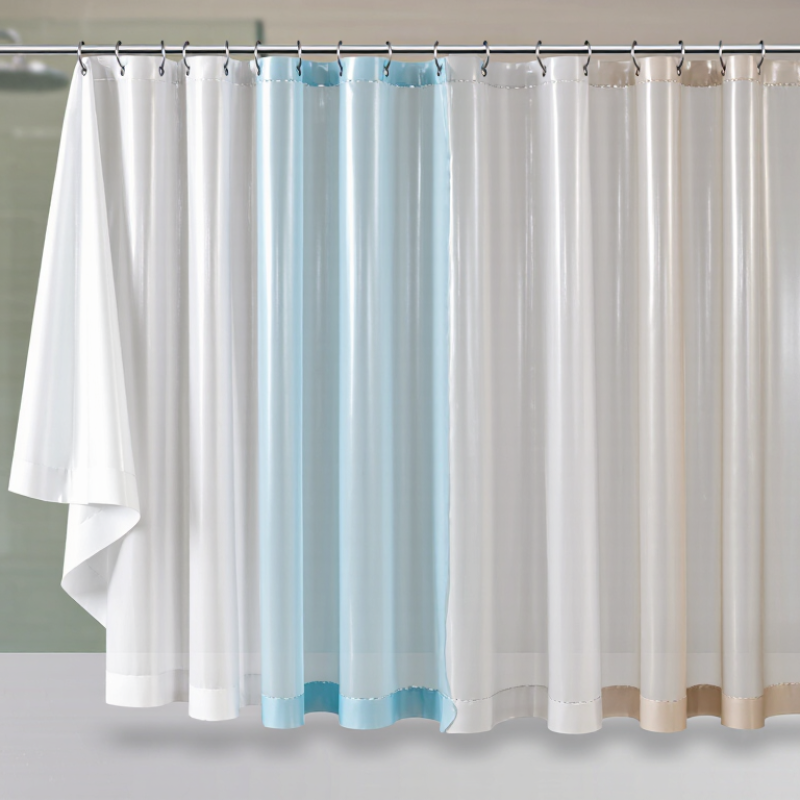
Clear PVC shower curtains suit compact bathrooms because light passes through and the shower feels less enclosed. They also reveal water spots quickly. Frosted curtains soften the view while still letting daylight through, making them useful near a window or shared vanity. Embossed textures add grip-like visual detail without relying on a printed design. They can, however, collect soap residue in their grooves. Small detail.
Patterned PVC brings color to plain tile, while solid-color styles create a calmer backdrop. Choose patterns with enough contrast to remain visible in dim bathrooms. Weighted-bottom curtains use a heavier lower edge to help limit billowing during a shower. They may still move when ventilation is strong. A reinforced-header style adds support around the hanging holes, which matters when a curtain is opened and closed often. The header needs careful inspection; not every reinforced edge feels equally sturdy.
Match the curtain width and length to the rod before buying. A curtain that drags on the floor can stay damp, while a short one may let water escape. Check whether the surface is easy to wipe, and air out a new curtain if it has a noticeable odor. Clear vinyl can feel a little exposed, so I would not choose it for every bathroom. The best fit depends on light, privacy, and how much cleaning you are willing to do.
| PVC Curtain Type | Appearance | Privacy | Weight and Movement | Best-Suited Use | Practical Buying and Care Notes |
|---|---|---|---|---|---|
| 1. Clear PVC | Transparent, smooth sheet that lets light pass through. | Low; silhouettes and activity may be visible. | Usually hangs with a light, flexible drape; movement depends on thickness and bathroom airflow. | Small or dim bathrooms where maintaining a brighter, more open appearance is a priority. | Check the stated dimensions and thickness. Wipe with a soft cloth and mild soapy water; follow the care instructions supplied with the product. |
| 2. Frosted or Translucent PVC | Clouded or lightly opaque finish that diffuses light. | Moderate; obscures detail more than clear PVC, but may not fully conceal shapes under strong backlighting. | Flexible; drape and movement vary with sheet thickness and construction. | Shared bathrooms or shower areas where a balance of light and added visual screening is wanted. | Confirm the actual opacity with a product sample or specification, as “frosted” appearance can vary between finishes. |
| 3. Embossed or Textured PVC | Raised, patterned, or pebbled surface rather than a fully smooth finish. | Often higher than clear PVC, depending on pattern depth and transparency. | Typically flexible; surface texture does not by itself determine overall curtain weight. | Bathrooms where a patterned look or reduced visibility is preferred over a plain transparent panel. | Choose a texture that can be wiped clean easily. Regularly spread the curtain after use so it can dry. |
| 4. Printed PVC | Printed motifs, colors, or decorative graphics on a PVC sheet. | Varies from low to high depending on print coverage and the opacity of the base material. | Depends on the base sheet, not simply on the printed design. | Guest bathrooms, family bathrooms, or spaces where decorative color is desired. | Check whether the print is on one or both sides and follow the maker’s cleaning guidance to help preserve the surface design. |
| 5. Weighted-Hem PVC | Usually a clear, translucent, or printed curtain with added weight along the lower edge. | Determined mainly by the curtain material and finish. | The weighted lower edge can help the curtain hang straighter and reduce billowing; it cannot eliminate movement in every shower. | Showers where a light curtain tends to move inward or lift during use. | Check how the weight is incorporated and whether the hem is sealed. Keep the lower edge clean and dry between uses. |
| 6. Opaque or Solid-Color PVC | Solid color or heavily covered surface with little or no transparency. | High; generally offers more visual screening than clear styles. | Varies with thickness and construction; opaque finish alone does not indicate heaviness. | Bathrooms where privacy and a coordinated, solid-color look matter most. | Check product specifications for light transmission and dimensions. Match the curtain width to the shower opening to allow adequate overlap. |
| 7. Extra-Thick PVC | Can be clear, translucent, textured, or printed, with a thicker sheet construction. | Depends on the chosen finish; thickness alone does not guarantee privacy. | Generally more substantial than a thinner sheet of the same design, though actual weight varies by product size and construction. | Buyers who prefer a sturdier-feeling curtain or a more substantial drape. | Compare stated thickness and finished weight rather than relying only on terms such as “heavy-duty.” Confirm that the rod and hooks are suitable for the curtain’s weight. |
Buyer note: PVC curtain performance varies by thickness, finish, dimensions, and construction. Check product specifications and care instructions before ordering; keep the bathroom ventilated and allow the curtain to dry between uses.
For global buyers, the 0.1% threshold deserves careful attention. Under EU REACH, suppliers must communicate information about a substance of very high concern (SVHC) when it exceeds 0.1% of an article’s weight. This is not a limit calculated against the entire shipment or a large product set. Not a ban. The threshold triggers information duties; it does not automatically mean a curtain cannot be sold.
A PVC shower curtain may include a panel, metal eyelets, and a weighted hem. Where components qualify as separate articles, assess them individually rather than relying only on the finished curtain’s total weight. Ask suppliers for an up-to-date SVHC declaration that identifies relevant components and the Candidate List version used. A laboratory report can help, but it may only cover selected substances. Composition records matter too.
Small details count. A clear declaration should name any SVHC above the threshold and provide available safe-use information. The Candidate List changes, so an old statement may no longer reflect current materials. One weak spot in procurement is treating “compliant” as a complete answer. It isn’t. Request traceable documents, check that they match the curtain’s actual construction, and keep the review date on file. Even careful paperwork has gaps; raise them before the product reaches your market.
When comparing PVC shower curtains for an international order, verify the material specification rather than relying on phrases like “heavy duty.” Ask for the PVC thickness, finished dimensions, and details about the eyelets and reinforced top edge. Confirm whether measurements use inches or centimeters; unit mix-ups can turn a good fit into an expensive return. Small details matter. Request a current product sheet or clear photos of the packaging, and check that the supplied item matches the listing. A strong odor or uneven seams are worth questioning, though appearance alone cannot confirm material quality.
Read the care instructions before buying. Check whether the curtain can be wiped with mild soap, and whether machine washing or bleach is prohibited. Follow the seller’s directions, since cleaning methods can affect the surface and printed design. Warranty terms need the same scrutiny: note the coverage period, start date, exclusions, and claim process. Ask whether the warranty applies in your delivery country and what evidence a claim requires. Ask for proof. Keep the invoice and product details together after delivery. I might still miss a small condition in the fine print; reviewing it carefully is less frustrating than discovering a limitation after the curtain has been installed.